Post-quantum Cryptography
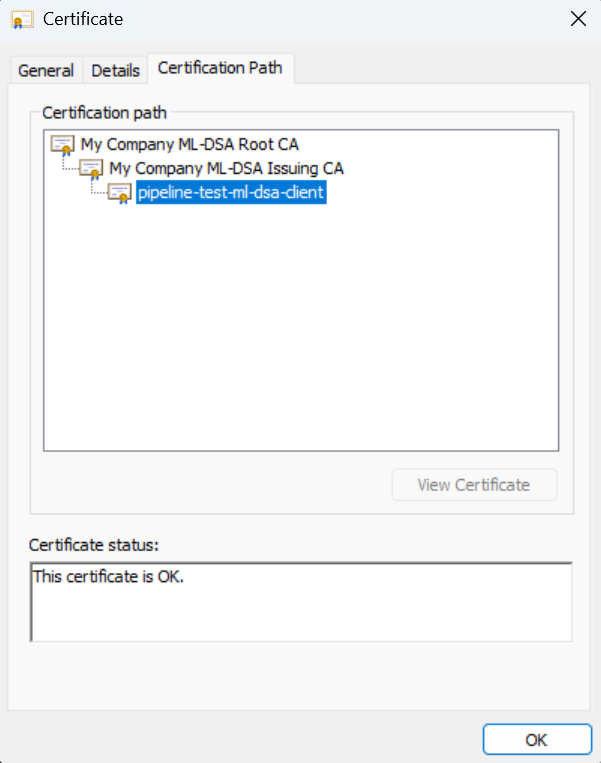
The serverless CA supports fully post-quantum CA hierarchies using ML-DSA (Module-Lattice Digital Signature Algorithm), NIST's primary post-quantum signature standard, defined in FIPS 204 with X.509 certificate profile per RFC 9881.
CA hierarchies are a priority for post-quantum migration: CA certificates are long-lived, and their signatures must remain trustworthy against "harvest now, forge later" adversaries with future quantum computers.
Supported algorithms
Choose the ML_DSA_44, ML_DSA_65 or ML_DSA_87 key spec for each CA independently
via the root_ca_key_spec and issuing_ca_key_spec Terraform
variables:
| Key spec | NIST security category | Public key | Signature |
|---|---|---|---|
| ML_DSA_44 | 2 (~AES-128) | 1,312 B | 2,420 B |
| ML_DSA_65 | 3 (~AES-192) | 1,952 B | 3,309 B |
| ML_DSA_87 | 5 (~AES-256) | 2,592 B | 4,627 B |
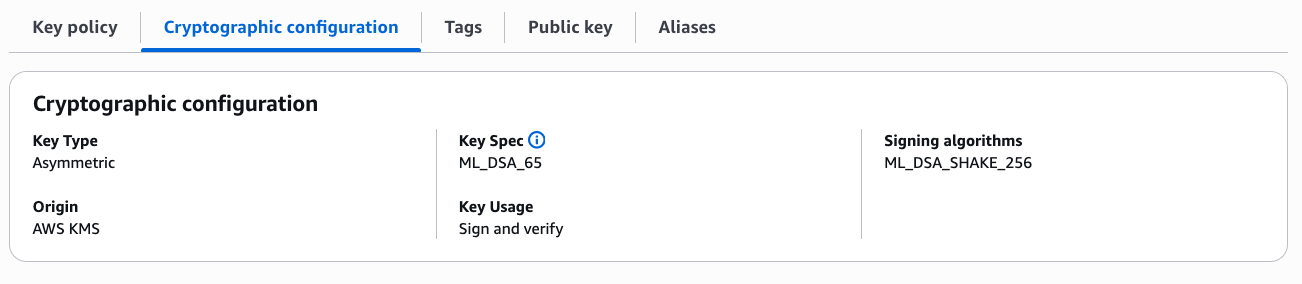
CA private keys are generated and used within AWS KMS FIPS 140-3 Security Level 3
validated HSMs, exactly as for RSA and ECDSA CAs, and cannot be exported. Certificate,
CSR and CRL signing uses the KMS ML_DSA_SHAKE_256 signing algorithm with the
EXTERNAL_MU message type, so CRLs of any size can be signed despite the 4,096-byte
KMS RAW message limit. Check
ML-DSA key spec availability
in your target AWS region before deploying.
Example deployment
The ml-dsa example
deploys an ML_DSA_65 root CA and ML_DSA_44 issuing CA with a public CRL, via the
GitHub Actions test workflow.
It shares an AWS account and Route53 hosted zone with the
rsa-public-crl
deployment, using project name pqc with the external_s3_bucket_name variable to
publish its CRLs and CA certificates via the classical deployment's existing S3 bucket
and CloudFront distribution.
Example CA certificates and CRLs
Locations below are for the example ML-DSA deployment, with project_name of pqc and
environment of prod (environment suffix automatically omitted for prod or prd
environments).
CRL Distribution Point (CDP) - DER format
| environment | hosted zone domain | CDP - Root CA | CDP - Issuing CA |
|---|---|---|---|
| prod | ca.celidor.io | http://ca.celidor.io/pqc-root-ca.crl | http://ca.celidor.io/pqc-issuing-ca.crl |
CRL - PEM format
| environment | hosted zone domain | Root CA | Issuing CA |
|---|---|---|---|
| prod | ca.celidor.io | http://ca.celidor.io/pqc-root-ca.crl.pem | http://ca.celidor.io/pqc-issuing-ca.crl.pem |
Authority Information Access (AIA)
| environment | hosted zone domain | AIA - Root CA | AIA - Issuing CA |
|---|---|---|---|
| prod | ca.celidor.io | http://ca.celidor.io/pqc-root-ca.crt | http://ca.celidor.io/pqc-issuing-ca.crt |
CA Bundle (for TrustStore)
| environment | hosted zone domain | CA Bundle |
|---|---|---|
| prod | ca.celidor.io | http://ca.celidor.io/pqc-ca-bundle.pem |
End-entity certificates
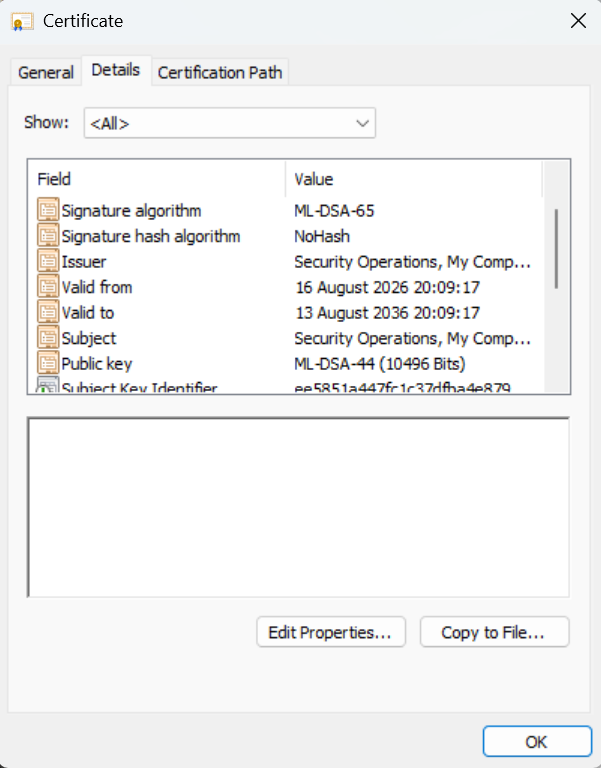
- CSR flow: fully post-quantum end-entity certificates - generate an ML-DSA key pair
and CSR with the client utilities
(
generate_key("ml-dsa-44")) or OpenSSL 3.5+ - No-CSR (GitOps) flow: AWS KMS
GenerateDataKeyPairdoesn't yet support ML-DSA, so subject key pairs remain classical (ECC_NIST_P256) under the post-quantum chain - chain signatures are still quantum-safe
A fully post-quantum issuing CA certificate is roughly 5-6 KB, an end-entity certificate with an ML-DSA-44 subject key roughly 4 KB, compared to around 1 KB for a typical ECDSA certificate.
Certificate Revocation Lists
ML-DSA CRLs work identically to classical CRLs, signed by the CA private key in AWS
KMS, published on the schedule set by the schedule_expression Terraform variable.
See Revocation for details.
Compatibility
Relying parties must support ML-DSA certificates:
- OpenSSL 3.5+, Java 25+, and Python
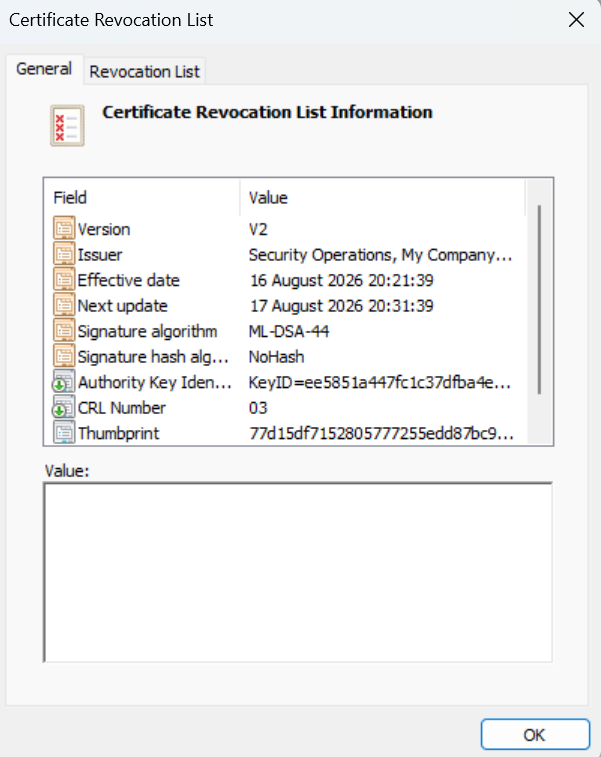
cryptography48.0.0+ can verify ML-DSA certificate chains - Microsoft Windows 11 (2025 updates onwards) imports and displays ML-DSA
certificates - the signature hash algorithm is shown as
NoHash, expected as pure ML-DSA signs the message directly without a separate hash algorithm - AWS IAM Roles Anywhere supports ML-DSA trust anchors and end-entity certificates
- Apple macOS Keychain does not support ML-DSA certificates and errors on import (as of Aug 2026)
- Other AWS managed mTLS services (ALB trust stores, API Gateway mTLS) and browsers do not accept ML-DSA certificates (as of Sep 2026)
ML-DSA is opt-in per CA deployment, so a classical hierarchy can run in parallel, as in the example deployment above.
To inspect an ML-DSA certificate or CRL with OpenSSL 3.5+:
curl -sO https://ca.celidor.io/pqc-ca-bundle.pem
openssl x509 -in pqc-ca-bundle.pem -text -noout
curl -s https://ca.celidor.io/pqc-issuing-ca.crl.pem | openssl crl -text -noout
Test ML-DSA Certificate Authority
Issue a fully post-quantum client certificate from an ML-DSA CA deployed using the ml-dsa example, with AWS credentials for the CA AWS account:
git clone https://github.com/serverless-ca/terraform-aws-ca.git
cd terraform-aws-ca
pip install -r utils/requirements.txt
python utils/client-cert.py --profile <your-aws-profile> --keyalgo ml-dsa-44 --project pqc
- an ML-DSA-44 key pair is generated locally, as AWS KMS
GenerateDataKeyPairdoesn't support ML-DSA -ml-dsa-65andml-dsa-87can also be selected - the CSR is signed with the local ML-DSA key and submitted to the
tls-certLambda function, which issues the certificate signed by the ML-DSA issuing CA --project pqctargets the ML-DSA deployment when more than one CA shares the AWS account, as in the example deployment - omit for an account with a single CA- certificate, private key (PKCS8) and CA bundle are written to the
~/certsdirectory
Verify the issued certificate with OpenSSL 3.5+:
openssl verify -CAfile ~/certs/ca-bundle.pem ~/certs/client-cert.crt
openssl x509 -in ~/certs/client-cert.crt -text -noout